The 13x vs 31x Gap: Why "AI for Productivity" Is a Ceiling, Not a Strategy
· 7 min read
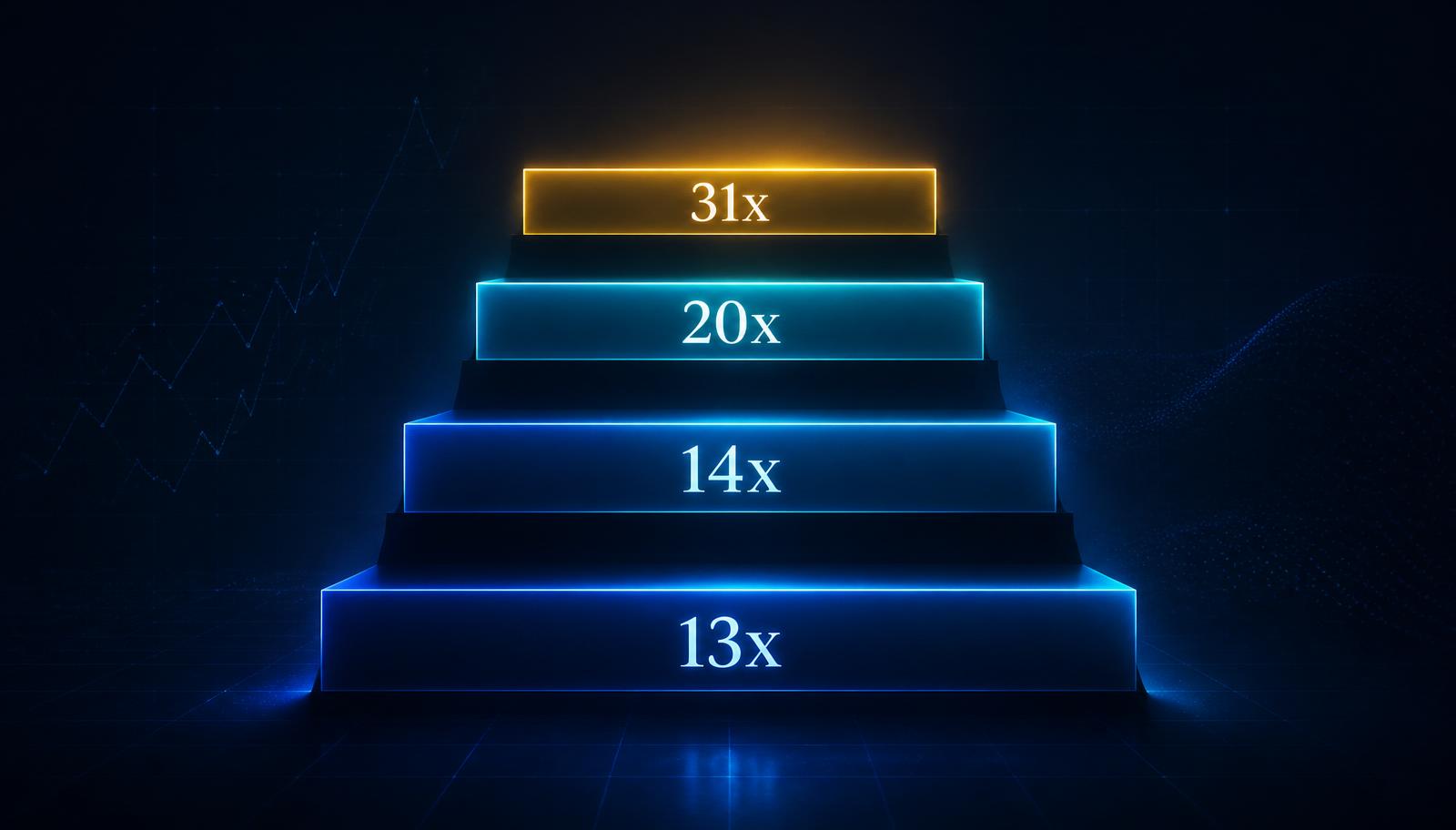
McKinsey just put a price on the AI maturity gap. Companies using AI for back-office productivity trade at a median 13–14x revenue multiple. Companies that embed AI into their products trade at 20x. Companies that build entirely new AI-native business lines trade at 31x. The gap between "we use ChatGPT" and "AI is our product" is a 2.3x valuation delta — and it is widening every quarter.
Two 2026 McKinsey research pieces — Beyond productivity: How AI creates value in private equity (June 2026) and For industrials, the next decade belongs to builders (May 2026) — independently arrive at the same conclusion. The market is no longer paying for AI efficiency. It is paying for AI that changes what a company sells.
The four-rung ladder, translated for founder-led businesses
The private-equity study tracked 471 PE-backed companies across 31 industries and classified each into four AI maturity levels. Here is what each rung looks like inside a 40-person, $2M–$50M business — not a Fortune 500.
Level 1 — Opportunistic (median 13x revenue)
The team uses ChatGPT for emails. The marketing lead runs a copilot. There are pilots but no production AI. Nothing in the business would break if the AI subscriptions were cancelled tomorrow.
Level 2 — Operating model (median 14x revenue)
AI is stitched into internal workflows. Auto-generated call summaries. AI-drafted follow-ups. A chatbot on the support inbox. Head count grows more slowly than revenue. Real efficiency — invisible to buyers.
Level 3 — Embedded in the product (median 20x revenue)
The thing the company sells now has AI inside it. A recruiter's placement rate lifts because the platform screens candidates. A fleet operator's uptime lifts because the tires report themselves. This is where valuation math changes.
Level 4 — AI-native business building (median 31x revenue)
A new revenue line the company could not have offered without AI. Data monetization. Outcome-based pricing. An agentic service tier. McKinsey's data shows revenue per employee jumps ~52% moving from Level 3 to Level 4 — a $180,000 median lift.
The 2.3x delta. Level 1 companies trade at 13x revenue. Level 4 companies trade at 31x. Same industry. Same customers. Different answer to one question: does AI change what you sell?
Why the L1 → L2 jump is worth zero valuation points
The single most important finding in the McKinsey data is that the market does not materially reward productivity AI. The median revenue multiple at Level 1 is 13x. At Level 2 it is 14x. That is roughly a rounding error. Level 2 companies do get a ~20% lift in revenue per employee — real operational value — but public and private buyers do not price it in.
Why? Because productivity AI is now table stakes. Every competitor has the same copilots, the same drafting tools, the same meeting-summary bots. Efficiency that everyone has is not a moat. It is the cost of showing up.
The valuation step-change happens at Level 3 — when AI is embedded in the offering. That is a +43% multiple lift over Level 2. The next step (L3 → L4) adds another 55%.
What the industrials paper adds
McKinsey's May 2026 industrials piece points to the same pattern in a different sector. 88% of companies now use AI in at least one function. 62% are experimenting with or scaling agentic AI. Baseline adoption is done. The differentiator is what companies do next.
The paper estimates agentic AI will unlock $450–650 billion in annual revenue for global industrial and energy leaders by 2030, alongside 30–50% cost reductions. It calls out five plays that share one trait: each turns AI into a new revenue stream rather than a new cost saver.
- Recurring-revenue and outcome-based models — Goodyear's tire-as-a-service pays per mile, not per tire.
- D2C and B2B2C channels — 32% of manufacturer website visitors browse; fewer than 2% convert. Agentic AI closes that gap in weeks, not months.
- Data monetization — HERE Technologies aggregates location data from 70 OEMs and sells APIs to 1,300+ clients.
- Green ventures and circularity — recovery and reuse as scalable growth platforms.
- New materials and ingredients — regional processing anchored by AI-driven forecasting.
The framing that matters for a founder: McKinsey now describes venture building as a repeatable capability, not a one-off bet. That is exactly the discipline missing from most SMB AI conversations.
What this means for a $2M–$50M founder-led business
The temptation is to read McKinsey's PE research and dismiss it: "That's for the exit crowd. My business isn't for sale." That reading misses the point. The four-rung ladder is not a valuation exercise — it is a diagnostic for whether AI is actually changing your economics.
Three questions to answer honestly this quarter:
- What rung are you actually on? Most founders assume Level 2 and are on Level 1. Copilot subscriptions do not count. If AI vanished from your stack tomorrow, would customers notice?
- Where does your customer touch AI? Level 3 requires AI inside what they buy or use — not just how you built it. Dash Clip's clients feel the difference because the platform surfaces the right insight before the sales call. Creative Display Works's clients feel it because quoting is instant, not a three-day back-and-forth.
- What new revenue line could only exist because you built the platform? That is the Level 4 question. It is what turns a services business into an asset with recurring revenue and defensible margins.
The SMB version of "repeatable venture building"
McKinsey's playbook for enterprises is to centralize an AI platform team and let it accelerate portfolio companies. The equivalent inside a $10M business is not a platform team — it is a partner who has already built one. That is the shape of the Aries engagement: Discovery diagnoses which rung the business sits on, the AriesOS build moves the operation onto a unified AI-native platform, and the Growth Retainer keeps compounding new modules and new revenue lines instead of leaving after handoff.
Two hard truths from the McKinsey data worth internalizing:
- The window is closing. Every quarter, more companies climb from Level 1 to Level 3. First-mover valuation lift compresses as adoption spreads.
- Non-software companies get less multiple lift than software companies at each rung — 22x at Level 4 vs. 33x for software. But the direction is the same and the delta between rungs is still material. Every founder-led services business, wholesaler, and industrial operator has a Level 3 play.
What to do this quarter
- Score yourself honestly on the ladder. The AI Readiness Assessment is a 24-question, 7-dimension diagnostic that maps directly to the McKinsey rungs.
- Pick one workflow to move from Level 2 to Level 3. AI should live inside what the customer touches — not just how the back office runs.
- Instrument one recurring or outcome-based revenue stream. Even one contract shift from one-time fee to outcome-linked pricing changes the enterprise value math.
Frequently asked questions
What's the difference between AI productivity and AI-native business building?
AI productivity uses tools like ChatGPT, Copilot, or transcription to make existing work faster. AI-native business building embeds AI into the product or service the customer buys — or launches new revenue lines that only exist because the AI platform makes them possible. McKinsey's 2026 research shows productivity AI is worth roughly zero valuation lift (13x → 14x median revenue multiples). Embedded AI is worth 20x. AI-native business lines are worth 31x.
Does this research apply to companies under $50M revenue?
Yes. McKinsey's sample included companies with revenue as low as $1M. The valuation delta scales down but the pattern holds: the market rewards AI that changes what you sell, not AI that makes your team slightly faster. Founder-led $2M–$50M businesses actually have an advantage — smaller surface area to move up the ladder, faster to hit Level 3.
How long does it take to move from Level 2 to Level 3?
A focused AriesOS build takes 4–8 weeks to ship a Level 3 module — AI embedded in the customer-facing workflow. Moving the whole operation typically runs three to six months of iterative module launches on the Growth Retainer, rather than a single all-at-once cutover.
What does an AI-native platform look like for a services business?
For a recruiting firm, it looks like Invenio Search Group — a custom CRM/ATS with 12+ AI agents automating candidate intake, call prep, email drafting, and applicant analytics, resulting in an 85% lift in placement rate. For a manufacturing services business, it looks like Creative Display Works — one platform replacing seven tools, with AI-driven planning that cut late shipments 63%. The pattern is identical: unified data, AI in every module, no vendor lock.
Sources
- Pulido, Yegoryan, Bleys, Haas et al. Beyond productivity: How AI creates value in private equity. McKinsey & Company, June 2026.
- Jansen, Fiocco, Bauer, Jenkins et al. For industrials, the next decade belongs to builders. McKinsey & Company, May 2026.