AI Agents for Small Business: Hype, Reality, and What Actually Works
· 8 min read

Every founder has heard the pitch by now: deploy an AI agent and watch it run your sales follow-up, answer customers, reconcile invoices, and write your reports while you sleep. The demos look magical. Then the trial starts, and the agent confidently does the wrong thing — because it can't actually see your business.
The gap between the promise and the result isn't because AI agents don't work. It's because most of them are deployed in exactly the environment where they're guaranteed to disappoint: bolted onto a stack of eight disconnected tools, each holding a different fragment of the truth.
The pitch versus the reality
An AI agent is software that can take a goal, reason through the steps, use tools, and act — not just answer a question. That's a genuine leap beyond a chatbot. The problem is that an agent is only as good as the context it can reach.
When a small business buys a standalone "AI agent" product, here's what usually happens:
- It only sees one app. The agent lives inside your CRM or your help desk, so it has no idea what happened in billing, fulfillment, or the inbox.
- It guesses. Missing context gets filled with plausible-sounding fabrication, which erodes trust the first time it's wrong in front of a customer.
- It adds another silo. Now there's one more subscription, one more login, and one more disconnected data source to reconcile.
The result is an expensive autocomplete, not an operator. The technology isn't the issue — the foundation is.
What an AI agent actually is (in plain terms)
Strip away the jargon and an effective agent does four things: it understands a goal you give it, gathers the relevant information, takes an action using your real systems, and reports back. The difference between a toy and a tool comes down to two questions:
- What can it see? An agent with read access to your full operational picture makes decisions a single-app bot never could.
- What can it safely do? An agent that can act — update a record, send a reply, flag an invoice — saves real hours. One that can only suggest just creates more reviewing.
Where agents create real ROI for a $2M–$15M business
For an operationally stressed, founder-led company, the wins are concrete and measurable. The highest-return starting points tend to be:
- Sales follow-up. Agents that draft and time outreach based on the full deal history close the gap where leads go cold — the single most common revenue leak in a busy SMB.
- Operations and back office. Matching invoices, flagging anomalies, chasing approvals, and updating records across systems — the repetitive work that quietly consumes a team's week.
- Reporting and insight. Instead of someone exporting five spreadsheets every Monday, an agent assembles the numbers and surfaces what changed and why.
- Customer communication. First-line responses and status updates that are accurate because the agent can actually look up the order, the ticket, and the account.
None of this requires a moonshot. It requires the agent to have a complete, trustworthy view of the business.
The hidden tax: bolting agents onto eight disconnected tools
Most SMBs are running somewhere between five and ten SaaS products that don't talk to each other. Adding AI agents on top of that doesn't fix the fragmentation — it multiplies it. Each agent has to be wired into each tool, each integration breaks on its own schedule, and no single agent ever has the whole picture.
This is why the conversation about AI agents and the conversation about consolidating a fragmented software stack are really the same conversation. The unit cost of another subscription is the smallest part of the bill; the real tax is the integration sprawl and the data that's always slightly out of sync.
AI-native versus AI-bolted-on
There's a meaningful difference between software that had an AI feature added later and software where intelligence is the foundation. AI-native systems are built so that every module writes to one unified data layer, and agents are designed in from the start — with standard interfaces (such as the Model Context Protocol) that let them reach tools and context reliably instead of through brittle one-off connectors.
In practice, that means an agent isn't bolted to a single app. It operates across the whole business because the whole business shares one source of truth. That's the architecture that makes the impressive demos hold up in production. For a deeper look at how this is changing, see how agentic AI is reshaping sales.
A practical path forward
The mistake is trying to "do AI" everywhere at once. The approach that works for a growing company is sequential:
- Start with one or two high-ROI workflows where the time savings are obvious and measurable.
- Put them on a unified data layer so the agent works with complete context from day one.
- Prove the gains, then expand module by module — each new capability builds on the same foundation instead of adding another silo.
This is exactly the logic behind a modular, AI-native platform: priority modules first, more added as the business grows, all connected to one data layer with AI embedded throughout.
Where to begin
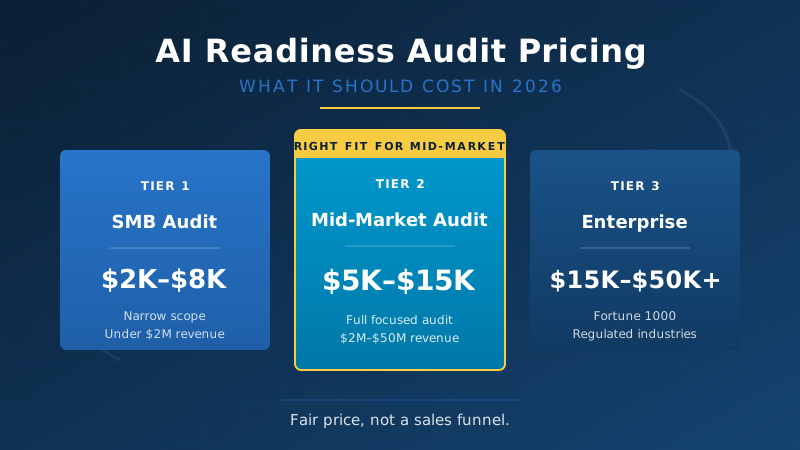
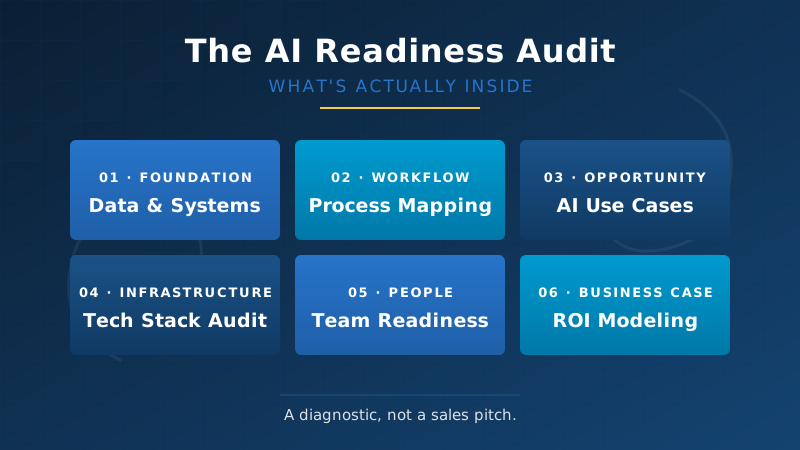
Before deploying a single agent, it's worth knowing which workflows are actually ready and where the data gaps are. That's the purpose of an AI Readiness Audit — a clear-eyed assessment of where AI agents will pay off and where the foundation needs work first.
AI agents are not hype. But they reward businesses that give them a real foundation, and they punish the ones that bolt them onto chaos. Build the foundation, start small, and let the wins compound.